
 BizSpace Portal
 Payroll Portal
 Supply Chain Financing
Board of Directors
Our Board of Directors is responsible for steering Yoma Bank’s strategy, heading its Leadership team, and ensuring that the Bank complies with all relevant laws and regulations when conducting its business.
Our Board is also responsible for shaping Yoma Bank’s corporate culture and values. Its goal is to create long-term value that benefits its shareholders and stakeholders. Our Board Members combine various skills and professional backgrounds, and this diversity elevates the quality of our decision-making.
The Board of Directors of Yoma Bank is elected by and is accountable to its shareholders. As part of the Bank’s continuing efforts to improve its corporate governance, the composition of the Board of Directors has been revised. The appointment of the Independent Non-Executive Directors exceeds the requirements of the Central Bank of Myanmar (CBM) regulations, and this enables the Bank to be in line with the best practices for corporate governance. Moreover, it ensures that decisions of the Board are made impartially in a manner that balances the best interests of the Bank’s shareholders, stakeholders, customers, and employees.
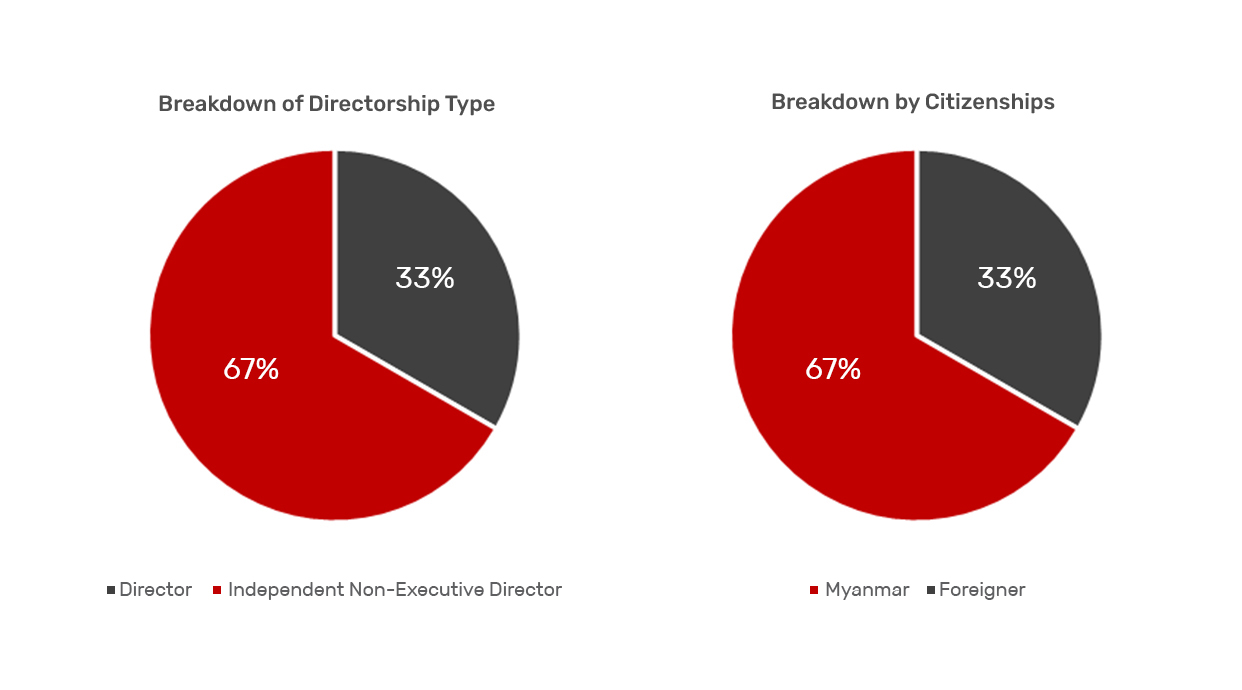
Board Composition
The Board of Directors of Yoma Bank comprises six members, the majority of whom are Independent Non‑Executive Directors. The Chairman of the Board is an Independent Non‑Executive Director and is responsible for leading the Board as well as overseeing all Board matters and proceedings.
The Chief Executive Officer (CEO), who reports to the Board, serves as an Executive Officer of the Bank. The CEO is entrusted by the Board with the authority to lead and manage the day‑to‑day business activities and operations of the Bank.
Definition of Independent Non‑Executive Director
In accordance with the Central Bank of Myanmar’s definition, an Independent Non‑Executive Director of a bank is an individual who holds less than 5% of the voting shares of the Bank and is not a Related Party as defined under the Financial Institutions Law (FI Law).
Independent Directors do not represent any shareholder. Therefore, they contribute objective judgement, diverse expertise, and independent perspectives to support the Board of the Directors in fulfilling its oversight responsibilities.
Limit on Other Directorships
Members of the Board of Directors of Yoma Bank may serve on a maximum of five boards of other public‑listed companies.
All members of Board of Directors currently comply with this requirement and do not exceed the limit.
Delegation by the Board
Yoma Bank further improved its corporate governance framework by establishing its Board Sub-Committees. The Bank now has three Sub-Committees, namely Audit Committee, Risk and Compliance Oversight Committee, and People, Remuneration and Nomination Committee. All Sub-Committees serve key functions within the Bank, assisting the Board of Directors in carrying out, without relinquishing, its duties and responsibilities. Each Committee is guided with its own Charter, as approved by the Board of Directors, which contain provisions on the scope of authority, competencies, composition, working procedures, and rights and responsibilities of members to ensure good governance.
Onboarding of Directors
Yoma Bank seeks Board members whose collective knowledge, experience, and skills offer a diverse range of perspectives to effectively guide the Bank in alignment with its strategic direction. The selection of new directors is based on the evolving needs of the Board and its Sub‑Committees to ensure the Board is optimally equipped to fulfill its responsibilities.
All directors must meet the Fit & Proper criteria stipulated in Directive No. (8/2019) issued by the CBM. In addition, the Board composition fully complies with the requirements set out in Directive No. (9/2019) on Directors of Banks, issued by the CBM.
In selecting new directors, Yoma Bank applies a Fit and Proper assessment based on three key criteria:
- Honesty, Integrity and Reputation: The individual must demonstrate a sound record of honesty, integrity, and reputation, with no material history of criminal or disciplinary proceedings, regulatory or legal breaches, dishonest or improper conduct, significant non-compliance, business failure, conflicts of interest, or other matters that may adversely affect their suitability to serve as a director.
- Competence and Capability: The individual must possess the appropriate qualifications, training, skills, experience, and expertise to effectively perform the duties and responsibilities of the position. The assessment also considers the individual’s track record, commitment, and understanding of the business, key risks, and relevant management processes.
- Financial Soundness: The individual must demonstrate financial soundness and the ability to meet financial obligations as they fall due. The assessment includes consideration of any material history of judgment debts, insolvency, or bankruptcy proceedings, whether in Myanmar or abroad.
Board Continuing Education
Yoma Bank provides a structured orientation program for newly appointed directors to help them become familiar with the businesses, board processes, internal controls, and governance practices, as well as other areas relevant to their responsibilities. The program typically includes access to strategic plans and objectives, management presentations, meetings with key members of the Leadership Team, site visits, and a peer‑pairing arrangement in which new directors are supported by experienced Board members during their initial months.
In addition to the initial orientation, the Bank ensures that directors have access to ongoing training and development opportunities as part of their continuous professional education. Directors are encouraged to regularly participate in workshops, conferences, and training programs to remain informed about market and industry developments and to support their continued professional growth at the expense of the Bank.
CEO Performance Assessment
The Board conducts an annual assessment of the Chief Executive Officer’s (CEO) performance. The assessment evaluates the CEO’s performance against agreed objectives and key performance indicators, covering areas such as financial performance, people and culture, customer outcomes, and strategic execution, all of which are aligned with the Bank’s vision, strategic priorities, and long‑term objectives. The results of the assessment are reviewed by the Board and are taken into consideration in remuneration decisions, succession planning, and leadership development initiatives.
Learn more about our corporate governance structure here.