 BizSpace Portal
 Payroll Portal
 Supply Chain Financing
Strategy
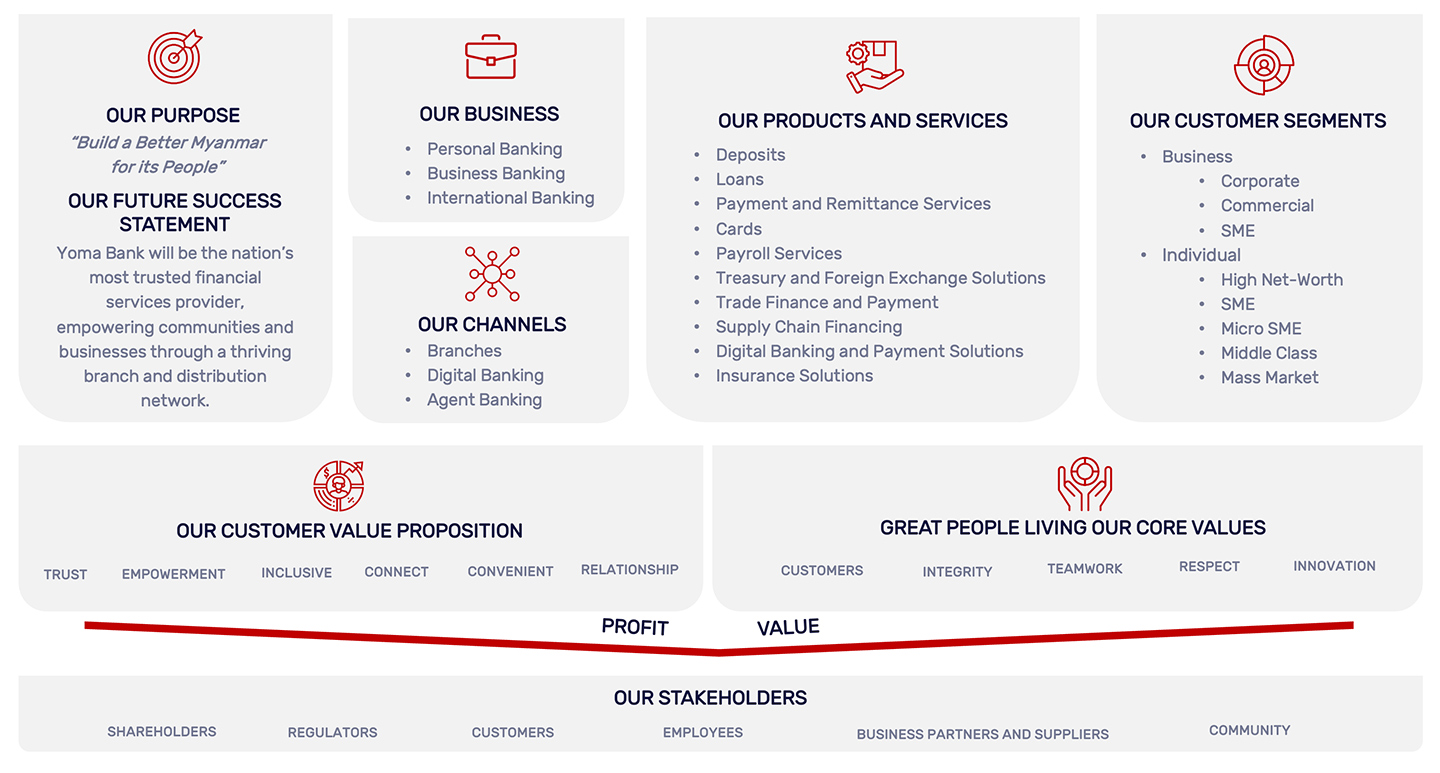
At Yoma Bank, we are driven by our purpose to Build a Better Myanmar for its People.
The Bank annually reviews the strategic agenda, considering the macro environment to forecast conditions and engages with its customers to assess its competitive position over short‑ to medium‑term horizons.
The objective of the Strategic Plan is to ensure alignment across the Bank and the Board of Directors on the strategic priorities that will guide the way forward of the organization for the current year while providing clear direction for the years ahead. The Strategic Plan is translated into a Plan on a Page, which defines the vision, strategic objectives, customer‑focused metrics, key customer outcomes, and value proposition, along with the foundational capabilities and resources required to achieve these strategic goals.
Yoma Bank adopts an Agile Organization Model designed to strengthen collaboration and drive long‑term success. Each year, the Bank defines a targeted set of strategic priorities that direct attention and resources to the areas of greatest impact. These priorities are then cascaded into structured SMART goals across all levels of the organization which enable a shared purpose, consistent performance tracking, and informed decision‑making throughout the year.
The Bank concentrates on delivering core products and services that matter most to customers and is advancing its journey to become a data‑driven organization to strengthen customer‑centric decision‑making and develop insight‑led strategies to enhance quality, improve efficiency, and deliver meaningful, measurable results.
| Strategic Objectives | |
| To focus on delivering impact to Myanmar businesses | Empowering Myanmar businesses by providing access to capital is crucial for building a better Myanmar. Small and large companies are the bedrock of our economy, and we aim to make it easy and simple for Myanmar’s businesses to access capital and financial services. |
| To become the main bank of our customers | We aim to elevate and deepen our relationships with our customers by fulfilling their financial needs. We will make the best use of technology to enhance customer experience and facilitate payment and banking operations. |
| To create growth and value for our shareholders | We aim to drive growth and create value for all our customers and shareholders alike. |
In addition to these strategic objectives, the Bank recognizes specific areas that require particular attention to further enable the successful execution of the strategy. Clear examples of these are:
- People – supported through the Way We Work program, which encompasses the responsibility matrix, competency matrix, performance management framework, the organization structure, and pay and benchmarking practices;
- Operations – with efforts directed toward optimizing processes and workflows to improve efficiency and service delivery;
- Risk – where the Bank aims to strike the right balance between growth aspirations and risk appetite; and
- Compliance – with a continued focus on strengthening AML (Anti-Money Laundering) and KYC (Know Your Customer) practices as customer base expands.
All employees across Yoma Bank are committed to delivering the Strategic Plan and its objectives, working collectively towards driving innovation and uplifting capability to better serve customers.
Board Strategic Review and Oversight
The Board of Directors oversees the Bank’s strategic direction through a structured process of annual review and ongoing performance monitoring. Each year, the Board reviews and approves the strategic priorities, business plan, budget, risk appetite, and key performance targets. Throughout the year, the Board receives regular updates from Management, monitors progress against strategic objectives, challenges key assumptions, and evaluates emerging risks and opportunities. This process ensures that the long-term objectives remain aligned with its Mission and Vision, risk appetite, and commitment to sustainable value creation.
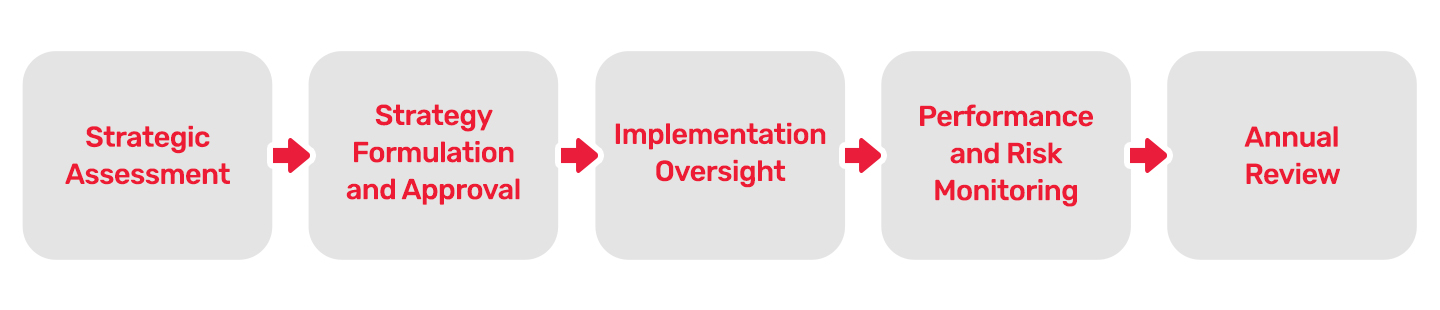
Strategic Assessment: Management assesses the operating environment, market trends, regulatory developments, and key risks and opportunities.
Strategy Formulation and Approval: The Board reviews, challenges, and approves the Bank’s strategic priorities, annual business plan, budget, risk appetite, and key performance targets.
Implementation Oversight: Management implements the approved strategy and provides regular updates on progress against strategic objectives and KPIs. The Board and its Board Committees review matters within their mandates and provide recommendations to support strategic oversight.
Performance and Risk Monitoring: The Board monitors financial and operational performance, reviews significant variances, and assesses alignment with the Bank’s risk appetite.
Annual Review: The Board conducts an annual review of strategy and, where necessary, updates strategic priorities to respond to changing business and market conditions.
Our Business Model
Capital and Debt Structure
The Management, through ALCO, reviews the capital and debt structure monthly as a matter of critical importance. Following which, the Management reports the findings to the Board on a quarterly basis. These reviews ensure that capital and debt levels remain within the defined risk appetite of the Bank and are aligned with its strategic priorities and long‑term sustainable success.
Crisis Response
Recognizing the challenging operating environment in Myanmar, driven by the pandemic, natural disasters, ongoing political situations, and economic uncertainties, the Board of Directors and Management have taken proactive steps to safeguard the operational resilience of the Bank. In response to heightened instability and volatility, the Bank has strengthened its risk identification and management processes and established comprehensive mitigation plans to ensure that essential financial services continue to be delivered to customers at an optimal level.
Yoma Bank remains committed to maintaining continuity of operations and providing reliable, uninterrupted banking services by undertaking the crisis response actions outlined below.
- Crisis Management Team: The Bank first established its Crisis Management Team (CMT) during the pandemic to oversee the operational execution of the Business Continuity Plan (BCP). The BCP sets out four defined crisis levels (Black, Red, Amber, and Green), specific triggers, required response actions, and expected service levels. The Bank has also instituted a Call Tree system across the organization to ensure timely and coordinated communication, action, and response during disruptions.
- Responses to Natural Disasters: The Bank prioritizes three key areas when responding to natural disasters: 1) Employee Safety and Well‑being, by conducting immediate needs assessments and post‑event inspections to safeguard employees during and after disaster events, 2) Continuity of Banking Services, by ensuring uninterrupted operations through activation of the BCP and swift restoration of services across affected areas, 3) Customer Support and Relief Measures, by providing proactive support to customers in impacted regions through loan restructuring, principal‑pause programs, and continued access to essential banking services.
- Liquidity Management: The Assets and Liabilities Committee (ALCO) monitor the composition and volume of assets and funding sources and ensures that liquidity and capital adequacy remain aligned with regulatory expectations and the Bank’s own risk appetite. Despite ongoing logistical and security challenges, the Cash Management Team has played an essential role in sustaining service continuity by ensuring adequate cash reserves across the branch network, thereby supporting customer service standards and operational stability.